SEO

Google Maps is the new way to manage your business

Google Maps is the new way to manage your business

The Google My Business mobile app is no longer available.

You can no longer manage your business profile, interact with customers, or view insights using the Google My Business mobile app for iOS or Android. The app now informs you that “the Google My Business app is no longer available” when you attempt to access it.

Here is the screenshot I got, when I liked to access Google My Business App on my Smartphone:
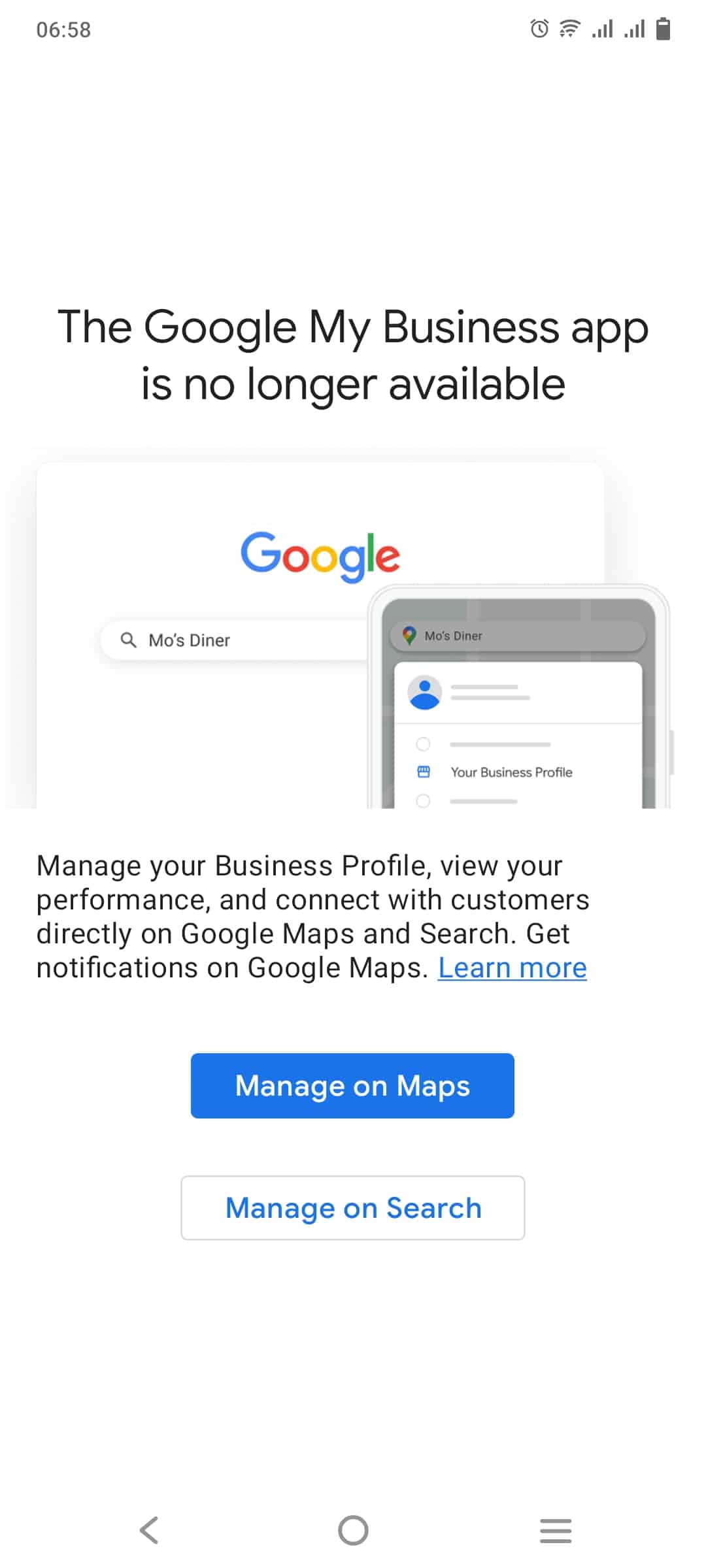
The Google My Business mobile app is no longer available

Expected. This was anticipated because Google informed us back in November when it changed its name from Google My Business to Google Business Profile that the Google My Business app would be totally retired in 2022. That time has finally arrived.

What now? You should manage your Google Business Profile via Google Search or the Google Maps app, advises Google. According to Google, you can manage your business profile, track your progress, and communicate directly with clients on Google Maps and Search. Install Google Maps and sign in with your Business Profile so you may receive notifications directly from the app as well.

Email. In a late-night email to businesses, Google also announced that the Google My Business mobile app would be discontinued in July 2022 and that the Google Maps app would be the best option for responding to customer messages on mobile. To receive email and Google Maps push alerts for new incoming messages, turn on your notifications. Additionally, you can reply to communications from your Google Business Profile.
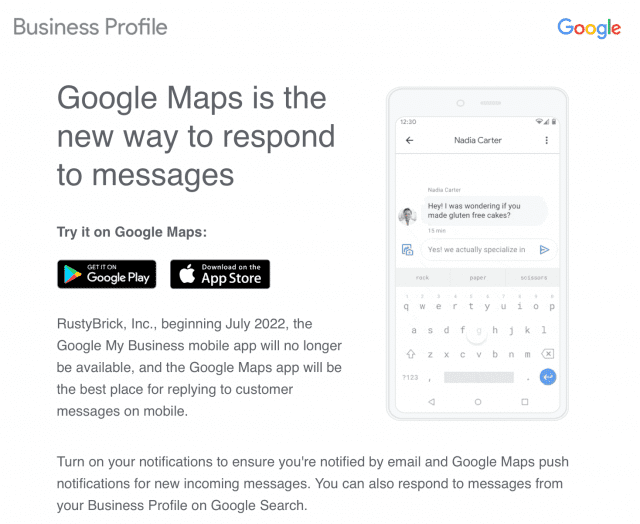
Google Maps is the new way to respond to messages

Why we care. You will need to move to utilising the Google Maps app or Google Search if you were used to using the Google My Business app to communicate with clients, edit your business page, check performance, and more. Google had already informed us of this change’s impending arrival and has even sent us many emails to that effect. The Google My Business app is no longer, therefore it has.

Do you have any questions?

It doesn’t hurt, but AI bots rarely use it. Clear answers, real proof and mentions on other sites matter far more.

AI tools can significantly enhance advanced SEO by automating repetitive tasks, improving keyword research (identifying trends and related keywords), assisting with content generation (outlines and initial drafts), analysing competitors’ strategies, identifying link-building opportunities, and monitoring real-time website performance. This allows human SEO experts to focus on higher-level strategic thinking, creativity, and building E-E-A-T signals.

Measuring GEO success involves tracking metrics beyond traditional organic clicks:

  • Citation Frequency: How often your content or brand is cited in AI responses.
  • Brand Mentions: The volume and sentiment of brand mentions across AI engines and other platforms.
  • Traffic Quality: Analysing the engagement and conversion rates of visitors who originate from AI-powered referrals.
  • Share of Voice: Your brand’s overall visibility across various AI-powered platforms.
  • Domain Authority & Author E-E-A-T Scores: Continuously monitoring and boosting these foundational metrics.

Use categories and tags effectively, implement a content calendar, utilise user roles and permissions, and consider using a content management plugin for complex sites.

Claim and fully complete your Google Business Profile (formerly Google My Business), keep your business name, address and phone number (NAP) identical everywhere online, collect genuine customer reviews and reply to them, add LocalBusiness structured data to your website, and create content about the places you serve.

Add social sharing buttons to your content, display social media feeds on your site, use social login options, and create open graph meta tags for better social sharing.

Ask ChatGPT, Perplexity and Google the questions your customers would ask. Run each question a few times and repeat it monthly, as answers change.

AI Overviews are AI-generated summaries shown at the top of Google’s regular results. AI Mode is Google’s separate, conversational search experience for longer and more complex questions. Since 2026 the two work as one flow: a user can move from an AI Overview straight into a follow-up conversation in AI Mode. Both can lead to “zero-click” searches, where people get an answer without visiting a website. This can reduce organic clicks for simple questions, but the visitors who do click through are usually better qualified. For SEO, the focus shifts to being cited as a trusted source in these AI answers: clear, well-structured content, strong E-E-A-T signals, structured data and consistent brand mentions across the web.

Technical SEO remains foundational. Ensuring your site has a robust technical infrastructure (fast page speed, mobile-friendliness, secure connections, clear crawlability, proper indexation) allows AI bots to easily access, understand, and process your content. Structured data implementation, proper use of robots.txt, sitemaps, and handling duplicate content are all critical technical aspects that directly influence how well your content can be understood and utilised by generative AI.

SEO is a long-term strategy. While some improvements can be seen within weeks, significant results typically take 3-6 months or longer, depending on competition and other factors.

You may also be interested in this

Ready to maximise your visibility and turn leads into valuable customer relationships?

Please contact us directly using the form.

"*" indicates required fields

Name*